
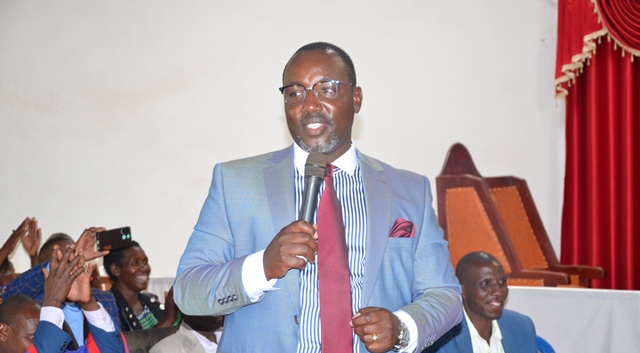
Bruce Balaba Kabaasa has urged the government to implement far-reaching reforms in Uganda’s education system, arguing that the current exam-driven structure limits learners’ overall development.
Reflecting on his academic journey, Kabaasa said he studied entirely in rural schools, beginning at Bufundi College Kacereere.
He added that his service on the council of Makerere University, along with exposure to international education systems, has shaped his views on effective learning models.
“Education from nursery up to Senior Four should be treated as basic education, with a strong emphasis on literacy, character building, and practical life skills instead of early exam pressure. Learners at this stage should mainly develop the ability to read, write, communicate well, and understand their environment,” Kabaasa said.
He criticized the practice of subjecting young learners to national examinations, saying it discourages creativity and promotes memorization rather than genuine understanding.
Kabaasa pointed to countries such as United States and Japan, where major examinations are typically taken at later stages, allowing for a more balanced approach that emphasizes discipline, culture, and innovation.
“Uganda’s current system contributes to school dropouts, as many students quit due to fear of failure or being labeled unsuccessful at an early age. This undermines national development by creating a discouraged population,” he added.
He proposed that the first national examination should be conducted at Senior Four, in line with Uganda’s policy on basic education, and recommended aligning Advanced Level studies more closely with university programs to better prepare students for specialized careers.
Kabaasa also called for strengthening community-based schooling, where learners study within their local areas to increase parental involvement, improve school conditions, and reduce disparities between rural and urban institutions.
He said one of his priorities in Parliament will be to promote what he described as true foundational education—often referred to as “community schooling” in developed countries—where learning up to Senior Four focuses on essential skills and character development rather than exam performance.
